The wealth of nature plays a key role in the well-being of people worldwide. Nature, with all its essential functions, is the system that sustains life on our planet and keeps our climate livable.
However, our ecosystems are under unprecedented threat. Human activities have severely disrupted natural habitats in many parts of the globe. These lost ecosystems preserved biodiversity, held cultural values, stored carbon, contributed to reducing extreme temperatures, and regulated weather systems.
Our planet’s resilience depends on the genetic and species diversity found in these natural areas. Each ecosystem is a complex web of interactions, where every species plays a role in maintaining environmental balance.
By preserving and restoring the ecosystem, we are protecting biodiversity, sustaining human well-being, and creating a critical defense against the acceleration of climate change.
An international toolset to assess policies
There have been innumerable warnings of the effects of human impact on ecosystems. The 2019 Global Assessment Report of Biodiversity and Ecosystem Services (IPBES 2019) warns that up to one million species are threatened with extinction due to human activity. As a recent follow-up, the Sixth IPCC Assessment Report (IPCC 2023) highlights that effective ecosystem conservation and restoration are necessary to help protect biodiversity, build ecosystem resilience, and ensure essential ecosystem services in the face of a changing climate.
Significant efforts and resources are being directed toward ecosystem conservation and restoration to mitigate biodiversity loss and the effects of climate change. The Kunming-Montreal Global Biodiversity Framework and many other policy frameworks have been established to reverse biodiversity loss and adapt to climate change.
To translate these agreements and policy frameworks into real impact, actors implementing biodiversity conservation need tools to monitor the effectiveness of their actions and to guide the planning of their actions.
The PEOPLE-ECCO project, funded by the European Space Agency, aims to address the urgent need for ecosystem conservation by developing Earth Observation (EO) based tools that can help measure and enhance the effectiveness of conservation efforts.
Bringing EO to NGOs and CSOs
Non-governmental organizations (NGOs) and civil society organizations (CSOs) are at the forefront of ecosystem conservation. These organizations work on implementing conservation practices, collecting data and knowledge about the ecosystem, conducting scientific research, and advocating policy change.
The PEOPLE-ECCO project aims to advance the use of Earth Observation (EO) data by NGOs and CSOs. To achieve this, PEOPLE-ECCO will train these organizations in using EO data and tools and develop additional tools that answer their specific conservation questions.
By using EO tools, they will be better informed in their decision-making process regarding conservation measures and more able to demonstrate the results of their actions, also related to the targets set by the United Nations and other international treaties.
Co-developing with Early Adopters
A unique aspect of the PEOPLE-ECCO project is its co-design approach. The project team includes six NGO/CSOs active in ecosystem conservation that have been engaged from the proposal development stage. These are called Early Adopters in the project. The Early Adopters will work with the project team, from the development of the EO tools to the validation and evaluation.
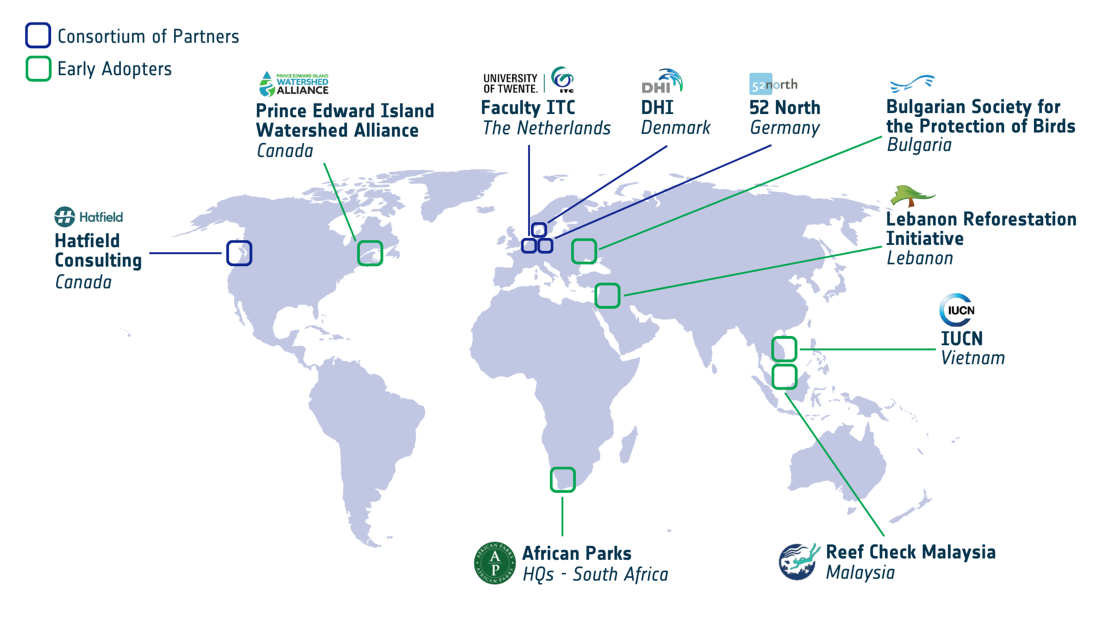
International Consortium of Partners and Early Adopters
The role of Early Adopters is to provide essential input, such as user needs, training material requirements, reference data, and expert knowledge about the ecosystems covered in the project. They will be the first to put the developed tools into practice, evaluate their quality and utility, and demonstrate their suitability to the wider community.
Global scale
PEOPLE-ECCO project operates on an international scale, on a wide range of ecosystems across multiple continents. This global approach is designed to ensure that the tools are applicable to different environmental contexts.
The project includes demonstration sites in Africa, Europe, Asia, and North America, each representing unique climatic conditions.
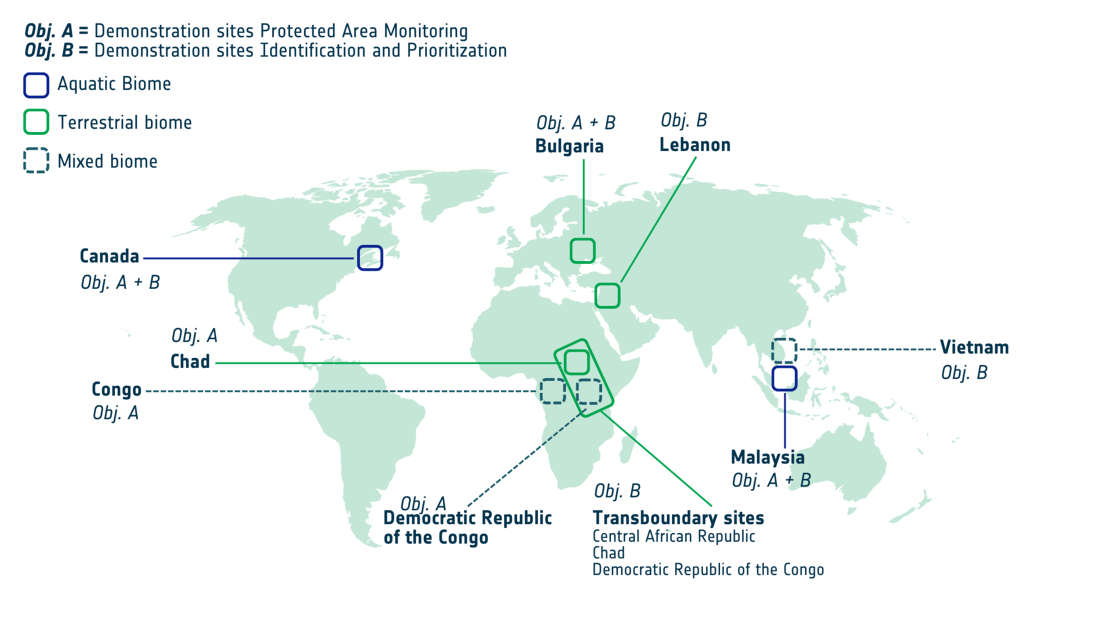
Demonstration sites
By developing methods and tools for this wide range of aquatic and terrestrial ecosystems, they have the potential to be scaled up further and be used by many more organizations worldwide. That’s why, by the end of the project, Early Adopters have a key role in showing what they already achieved and sharing it with other organizations in their networks.
Next steps
PEOPLE-ECCO kicked off on October 3rd 2024, with a meeting involving all Consortium Partners, Early Adopters, the European Space Agency, and the Advisory Board.
The project is now in a phase of assessing user needs through interviews, the next steps include consolidating requirements of the wider users’ community at ESA’s Biospace25 Conference, 10-14 February 2025 in Frascati, Italy.
More recent news
 Mon 29 Jun 2026PEOPLE-ECCO and Reef Check Malaysia meet on Coral Triangle Day to co-design tools for coral reef conservation
 Thu 9 Apr 2026African Parks and PEOPLE-ECCO: Earth Observation for conservation at a continental scale
 Fri 19 Dec 2025PEOPLE-ECCO’s second Early Adopter Living Lab
 Thu 25 Sep 2025Hatfield and IUCN collaborate to monitor land-use transitions in Northern Vietnam
 Thu 12 Jun 2025The road to data-driven conservation: Lebanon Reforestation Initiative